|
2002.05
Page 2 of 2
How the immune system works
Back to page one
|
|
 Complement Complement
The complement system consists of a series of proteins that work to "complement" the work of antibodies in destroying bacteria. Complement proteins circulate in the blood in an inactive form.
The so-called "complement cascade" is set off when the first complement molecule, C1, encounters antibody bound to antigen in an antigen-antibody complex. Each of the complement proteins performs its specialized job in turn, acting on the molecule next in line. The end product is a cylinder that punctures the cell membrane and, by allowing fluids and molecules to flow in and out, dooms the target cell.
|
 Mounting an Immune Response Mounting an Immune Response
Microbes attempting to get into the body must first get past the skin and mucous membranes, which not only pose a physical barrier but are rich in scavenger cells and IgA antibodies.
Next, they must elude a series of nonspecific defenses-cells and substances that attack all invaders regardless of the epitopes they carry. These include patrolling scavenger cells, complement, and various other enzymes and chemicals. Infectious agents that get past the nonspecific barriers must confront specific weapons tailored just for them.
These include both antibodies and cells. Almost all antigens trigger both nonspecific and specific responses.
|
 Antigen Receptors Antigen Receptors
Both B cells and T cells carry customized receptor molecules that allow them to recognize and respond to their specific targets. The B cell's antigen-specific receptor is a sample of the antibody it is prepared to manufacture; it recognizes antigen in its natural state.
The T cell receptor system is more complex. A T cell can recognize an antigen only after the antigen is processed and presented to it by a so-called antigen-presenting cell, in combination with a special type of cell marker. The T4 T cell's receptor looks for an antigen that has been broken down by an immune system cell such as a macrophage or a B cell and combined with a marker, known as a class II protein, carried by immune cells.
The T8 T cell's receptor recognizes an antigen fragment produced within the cell, combined with a class I protein; class I proteins are found on virtually all body cells. This complicated arrangement assures that T cells act only on precise targets and at close range.
|
 Activation of B Cells to Make Antibody Activation of B Cells to Make Antibody
The B cell uses its receptor to bind a matching antigen, which it proceeds to engulf and process. Then it combines a fragment of antigen with its special marker, the class II protein.
This combination of antigen and marker is recognized and bound by a T cell carrying a matching receptor. The binding activates the T cell, which then releases lymphokines-interleukins-that transform the B cell into an antibody- secreting plasma cell.
|
 Activation of T Cells: Helper and Cytotoxic Activation of T Cells: Helper and Cytotoxic
After an antigen-presenting cell such as a macrophage has ingested and processed an antigen, it presents the antigen fragment, along with a class II marker protein, to a matching helper T cell with a T4 receptor.
The binding prompts the macrophage to release interleukins that allow the T cell to mature. A cytotoxic T cell recognizes antigens such as virus proteins,which are produced within a cell, in combination with a class I self-marker protein. With the cooperation of a helper T cell, the cytotoxic T cell matures.
Then, when the mature cytotoxic T cell encounters its specific target antigen combined with a class I marker protein-for instance, on a body cell that has been infected with a virus-it is ready to attack and kill the target cell.
|

 Immunity: Short- and Long-Term Cell Memory Immunity: Short- and Long-Term Cell Memory
Whenever T cells and B cells are activated, some become "memory" cells. The next time that an individual encounters that same antigen, the immune system is primed to destroy it quickly.
Long-term immunity can be stimulated not only by infection but also by vaccines made from infectious agents that have been inactivated or, more commonly, from minute portions of the microbe.
Short-term immunity can be transferred passively from one individual to another via antibody-containing serum; similarly, infants are protected by antibodies they receive from their mothers (primarily before birth).
|
TOP
|
 Disorders of the Immune System: Allergy Disorders of the Immune System: Allergy
When the immune system malfunctions, it can unleash a torrent of disorders and diseases. One of the most familiar is allergy.
Allergies such as hay fever and hives are related to the antibody known as IgE. The first time an allergy-prone person is exposed to an allergen-for instance, grass pollen-the individual's B cells make large amounts of grass pollen IgE antibody. These IgE molecules attach to granule-containing cells known as mast cells, which are plentiful in the lungs, skin, tongue, and linings of the nose and gastrointestinal tract.
The next time that person encounters grass pollen, the IgE-primed mast cell releases powerful chemicals that cause the wheezing, sneezing, and other symptoms of allergy.
|
 Disorders of the Immune System: Autoimmune Disease Sometimes the immune system's recognition apparatus breaks down, and the body begins to manufacture antibodies and T cells directed against the body's own cells and organs. Disorders of the Immune System: Autoimmune Disease Sometimes the immune system's recognition apparatus breaks down, and the body begins to manufacture antibodies and T cells directed against the body's own cells and organs.
Such cells and autoantibodies, as they are known, contribute to many diseases. For instance, T cells that attack pancreas cells contribute to diabetes, while an autoantibody known as rheumatoid factor is common in persons with rheumatoid arthritis.
PPS note:Pemphigus is caused when the body creates antibodies against desmoglein cells, the cells which hold skin cells together. As the skin separates, lesions (blisters) are formed.
Pemphigoid is caused by ____________
|
Disorders of the Immune System: Immune Complex Disease
Immune complexes are clusters of interlocking antigens and antibodies. Normally they are rapidly removed from the bloodstream. In some circumstances, however, they continue to circulate, and eventually they become trapped in and damage the tissues of the kidneys, as seen here, or in the lungs, skin, joints, or blood vessels.
|
Human Tissue Typing for Organ Transplants
For an organ transplant to "take," it is necessary to minimize the body's drive to rid itself of foreign tissue. One way is to make sure that the markers of self on the donor's tissue are as similar as possible to those of the recipient.
Because tissue typing is usually done on white blood cells, or leukocytes, the markers are referred to as human leukocyte antigens, or HLA. Each cell has a double set of six major antigens, HLA-A, B, and C, and three types of HLA-D.
Since each of the antigens exists, in different individuals, in as many as 20 varieties, the number of possible HLA types is about 10,000. The genes that encode the HLA antigens, located on chromosome 6, are the subject of intense research.
|
 "Privileged" Immunity "Privileged" Immunity
A child in the womb carries foreign antigens from the father as well as immunologically compatible self antigens from the mother.
One might expect this condition to trigger a graft rejection,but it does not because the uterus is an "immunologically privileged" site where immune responses are subdued.
|
 Immunity and Cancer Immunity and Cancer
When normal cells turn into cancer cells, some of the antigens on their surface change. These new or altered antigens flag immune defenders, including cytotoxic T cells, natural killer cells, and macrophages.
According to one theory, patrolling cells of the immune system provide continuing bodywide surveillance, spying out and eliminating cells that undergo malignant transformation. Tumors develop when the surveillance system breaks down or is overwhelmed.
|
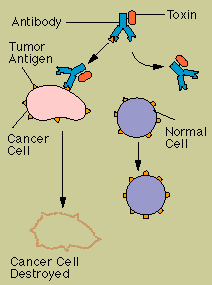 Immunotherapy Immunotherapy
A new approach to cancer therapy uses antibodies that have been specially made to recognize specific cancer. When coupled with natural toxins, drugs, or radioactive substances, the antibodies seek out their target cancer cells and deliver their lethal load. Alternatively, toxins can be linked to a lymphokine and routed to cells equipped with receptors for the lymphokine.
|
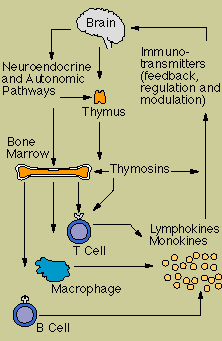 The Immune System and the Nervous System The Immune System and the Nervous System
Biological links between the immune system and the central nervous system exist at several levels. Hormones and other chemicals such as neuropeptides, which convey messages among nerve cells, have been found also to "speak" to cells of the immune system-and some immune cells even manufacture typical neuropeptides.
In addition, networks of nerve fibers have been found to connect directly to the lymphoid organs. The picture that is emerging is of closely interlocked systems facilitating a two-way flow of information.
Immune cells, it has been suggested, may function in a sensory capacity, detecting the arrival of foreign invaders and relaying chemical signals to alert the brain. The brain, for its part, may send signals that guide the traffic of cells through the lymphoid organs.
|
Hybridoma Technology
Thanks to a technique known as hybridoma technology, scientists are now able to make quantities of specific antibodies. A hybridoma can be produced by injecting a specific antigen into a mouse, collecting antibody-producing cells from the mouse's spleen, and fusing them with long-lived cancerous immune cells. Individual hybridoma cells are cloned and tested to find those that produce the desired antibody. Their many identical daughter clones will secrete, over a long period of time, the made-to-order "monoclonal" antibody.
|
 Genetic Engineering Genetic Engineering
Genetic engineering allows scientists to pluck genes-segments of DNA-from one type of organism and combine them with genes of a second organism.
In this way relatively simple organisms such as bacteria or yeast can be induced to make quantities of human proteins, including interferons and interleukins.
They can also manufacture proteins from infectious agents such as the hepatitis virus or the AIDS virus, for use in vaccines.
|
 The SCID-hu Mouse The SCID-hu Mouse
The SCID mouse, which lacks a functioning immune system of its own, is helpless to fight infection or reject transplanted tissue. By transplanting immature human immune tissues and/or immune cells into these mice, scientists have created an in vivo model that promises to be of immense value in advancing our understanding of the immune system.
|
|
Back to page one
|
|
